Building a clock I stalled on for five years, with an AI assistant
Those who’ve known me for a while know I essentially have an electrical engineering degree, and one of my hobbies about ten years ago was playing with Arduinos and microcontrollers. I’ve always wanted to build a clock with a NeoPixel ring, sitting on the wall, gently glowing with a couple of different changeable presets, but I never managed to get it over the line. The hardware has been in a box for at least one child’s life and one house move.
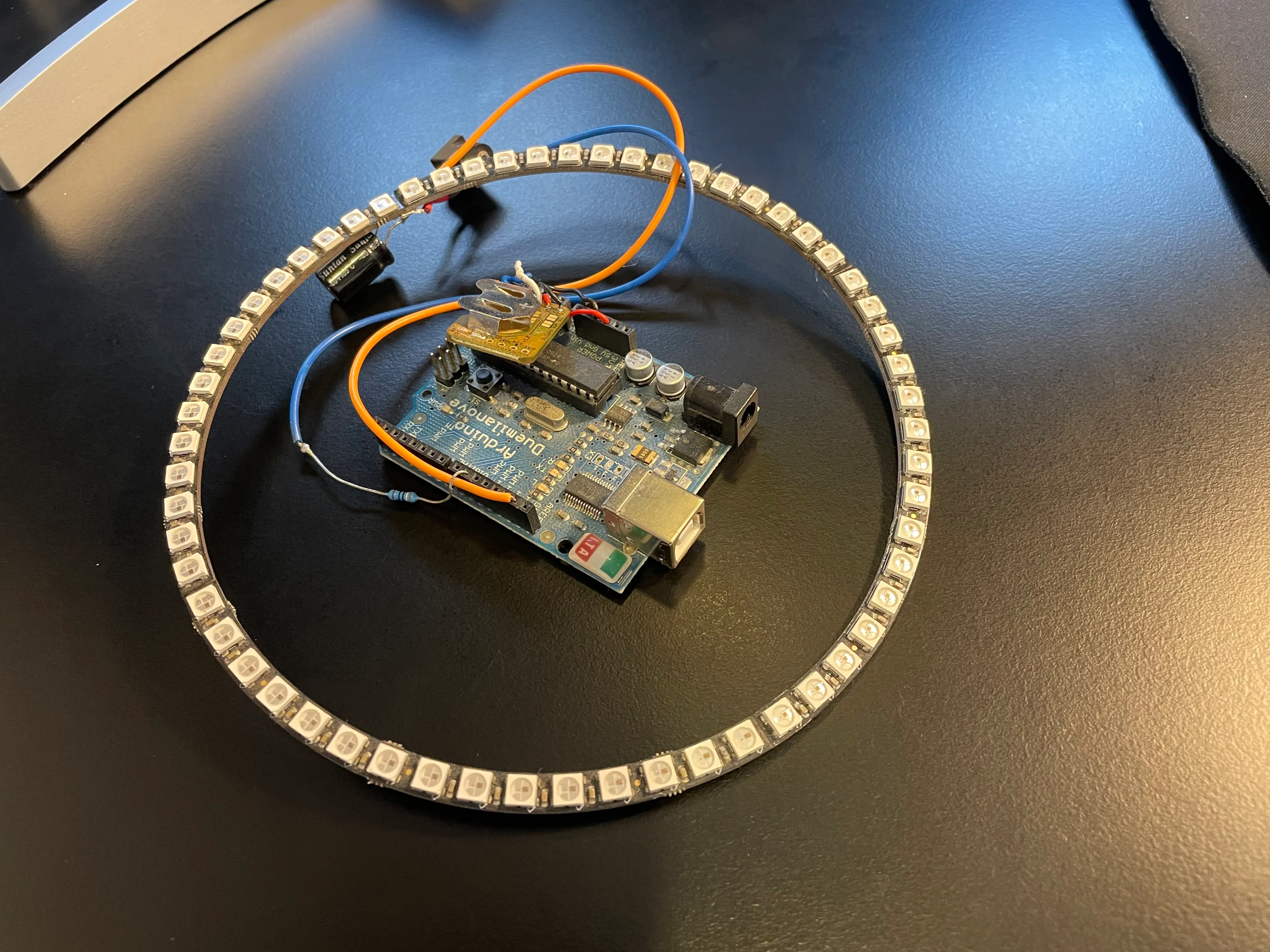
Last night I gave the project to an AI assistant. It basically one-shotted the whole thing, and on reflection that showed me exactly where I’d been getting stuck.
I understood the polling loop well enough: update inputs, do calculations, render. Where I kept hitting a wall was wanting different presets for how the clock should look, and trying to render elements with sub-second accuracy with a RTC module that only has second resolution. The missing link turned out to be state in C++ classes — keeping track of where each preset was between one tick and the next. Obvious in hindsight, but I never got there solo.
In about 10 minutes I had a project scaffolded. It took me longer to find all the parts and clean the dust off them. Uploaded to the Arduino board still wired to the light ring and it … just worked?
I have a bunch of different Arduinos that might have a new lease of life now. Embedded programming is somewhere I got very rusty, and with two young children I’m extremely time-poor — a barrier that did kill this project, for at least five years. Right now, models like these are more than capable of getting me started, unblocked, and iterating. That’s a completely different shape to how I would have done this twelve months ago.
Solid platform to play and extend from. The RTC battery is dead so it loses time on power loss — needs a CR2016. And I still need to work out how to build the enclosure and package it for the wall. Last time around I would have said laser-cut frosted plastic, but now I guess it’ll be a trip to the central library to use a 3D printer?
For the first time in years this project feels alive rather than stalled in my head.